
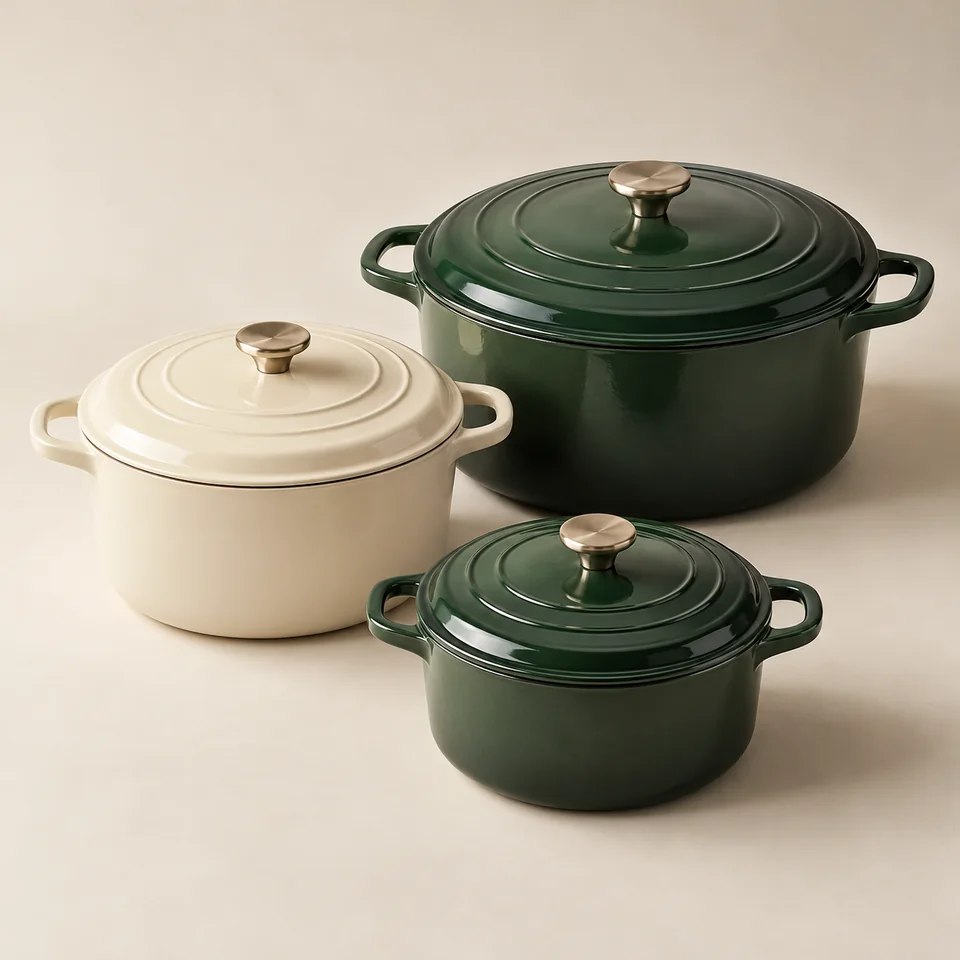
Choosing the right Dutch oven size can make a real difference in everyday cooking. A pot that is too small may leave little room for ingredients, while an oversized pot can take up unnecessary storage space and may not be the most convenient choice for smaller meals.
Dutch ovens are available in a wide range of capacities, from compact pots for small portions to larger models designed for family meals, batch cooking, and entertaining. However, capacity alone does not tell the whole story. Diameter, depth, shape, and product weight also influence how a Dutch oven fits your needs.
This guide compares common Dutch oven sizes in quarts and liters, explains approximate serving capacities, and helps you choose the right size for different cooking needs.
Quick Answer: A 5- to 6-quart Dutch oven is a versatile starting point for many households, while smaller 2- to 4-quart models suit smaller portions and larger 7- to 10-quart pots are useful for batch cooking and larger meals. The best size depends on your household, cooking habits, pot dimensions, and storage space.
Dutch Oven Size Chart: Quarts, Liters, and Servings
Dutch oven capacity is commonly expressed in US quarts. One US quart is approximately 0.946 liters, making it useful to compare both units when evaluating cookware specifications.
The following chart provides a general starting point for choosing a Dutch oven. Serving estimates are approximate and vary with the type of food, portion size, cooking method, and shape of the pot.
| Capacity | Approx. Liters | Typical Round Diameter* | Approx. Servings | Common Uses |
|---|---|---|---|---|
| 2 qt | 1.9 L | 18–20 cm | 1–2 | Small portions, sauces, side dishes |
| 3 qt | 2.8 L | 18–22 cm | 1–2 | Small meals, compact everyday cooking |
| 4 qt | 3.8 L | 20–24 cm | 2–4 | Everyday meals, soups, smaller braises |
| 5 qt | 4.7 L | 22–26 cm | 3–5 | Family meals, stews, casseroles |
| 5.5–6 qt | 5.2–5.7 L | 24–28 cm | 4–6 | Versatile everyday cooking, braising |
| 7–8 qt | 6.6–7.6 L | 26–30 cm | 6–8+ | Large meals, batch cooking, entertaining |
| 9–10 qt | 8.5–9.5 L | 28–34 cm | 8+ | Large batches, gatherings, commercial-style preparation |
Diameter ranges are indicative examples for common round cookware, not standardized capacity-to-diameter conversions. Actual dimensions vary by manufacturer, shape, wall thickness, and design. Oval Dutch ovens have different length and width proportions.
The most useful starting point is to consider both the quantity of food you prepare and the space available inside the pot. A deeper pot and a wider pot may have similar capacities but behave differently when browning ingredients, simmering liquids, or fitting larger cuts of meat.
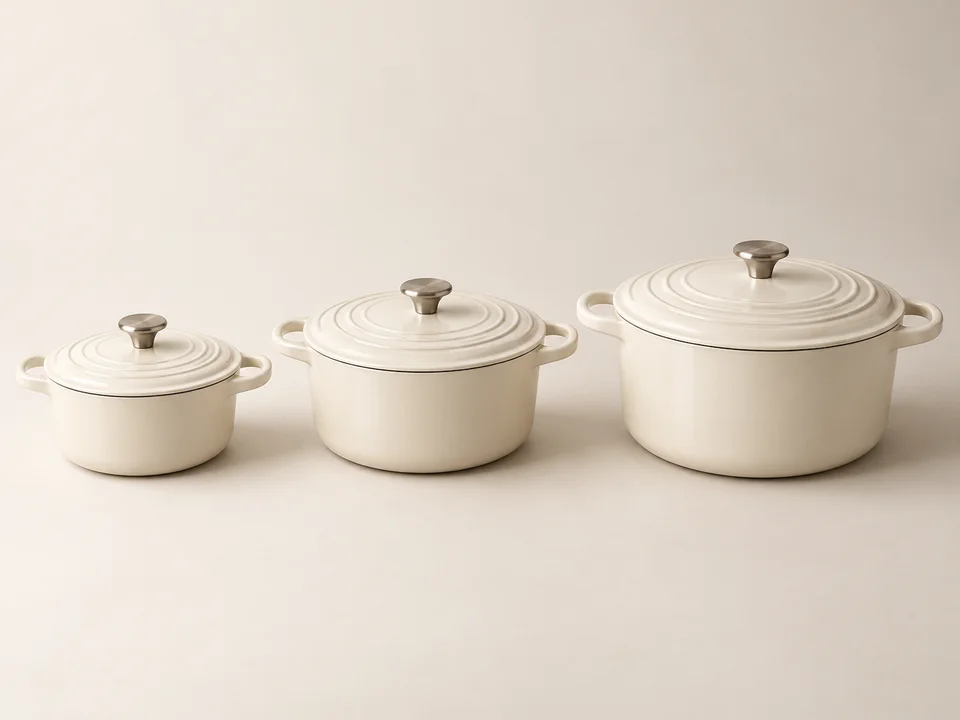
What Size Dutch Oven Do You Need?
The right Dutch oven size depends on how many people you usually cook for and whether you prepare individual meals or larger batches.
For One or Two People
A 2- to 3-quart Dutch oven may be suitable for smaller households, side dishes, sauces, and compact meals. These sizes are easier to store and may be more convenient when preparing modest quantities.
A 4-quart pot offers additional flexibility if you regularly prepare soups, small braises, or meals with leftovers.
For Two to Four People
A 4- to 5-quart Dutch oven can work well for everyday cooking in a smaller household. It provides room for many soups, stews, sauces, and braised dishes without requiring the space of a larger pot.
If you frequently cook extra portions for the next day, consider a slightly larger capacity.
For Four to Six People
A 5.5- to 6-quart Dutch oven is a versatile option for many family kitchens. It provides room for a variety of stews, braised meats, soups, and other one-pot meals.
This range can also be useful for buyers developing a core Dutch oven product offering, although the best size for a retail collection depends on the target market and customer preferences.
For Larger Families and Batch Cooking
A 7- to 8-quart Dutch oven offers more room for larger batches, family gatherings, and dishes that require substantial ingredients or liquid.
Pots of 9 quarts or more may be appropriate for large households, entertaining, and high-volume cooking. Before choosing a large model, consider its weight, storage requirements, and whether the available cooking surface can accommodate it comfortably.
These serving estimates are guidelines rather than fixed rules. A pot used for a thick stew may serve a different number of people from one used for a large roast or a dish with substantial liquid.
How to Read Dutch Oven Capacity, Diameter, and Depth
Capacity, diameter, and depth describe different aspects of a Dutch oven. Understanding all three helps prevent choosing a pot based on a single number.
Capacity: How Much the Pot Holds
Capacity describes the volume of the cooking vessel. It is commonly listed in US quarts or liters.
For quick conversion, use these approximate equivalents:
2 quarts = 1.9 liters
3 quarts = 2.8 liters
4 quarts = 3.8 liters
5 quarts = 4.7 liters
6 quarts = 5.7 liters
8 quarts = 7.6 liters
10 quarts = 9.5 liters
When comparing product specifications, check how the manufacturer measures nominal capacity. The stated volume should not automatically be treated as the amount of food or liquid that can be cooked without leaving additional space.
Diameter: The Available Cooking Surface
Diameter influences how much space is available for browning ingredients and arranging food inside a round Dutch oven.
A wider pot may make it easier to brown several pieces of meat in one layer. A narrower pot may offer a more compact footprint, even when its depth provides substantial capacity.
For this reason, two Dutch ovens with similar capacities can have different cooking surfaces.
Depth: The Space for Ingredients and Liquids
Depth affects how much vertical space is available for soups, stews, braises, and larger ingredients.
A deeper pot may accommodate more liquid within a relatively compact footprint. A shallower design may provide a wider cooking surface that is convenient for browning ingredients before adding liquid.
Neither design is universally better. Consider the dishes the pot is intended to prepare and the available cooking space.
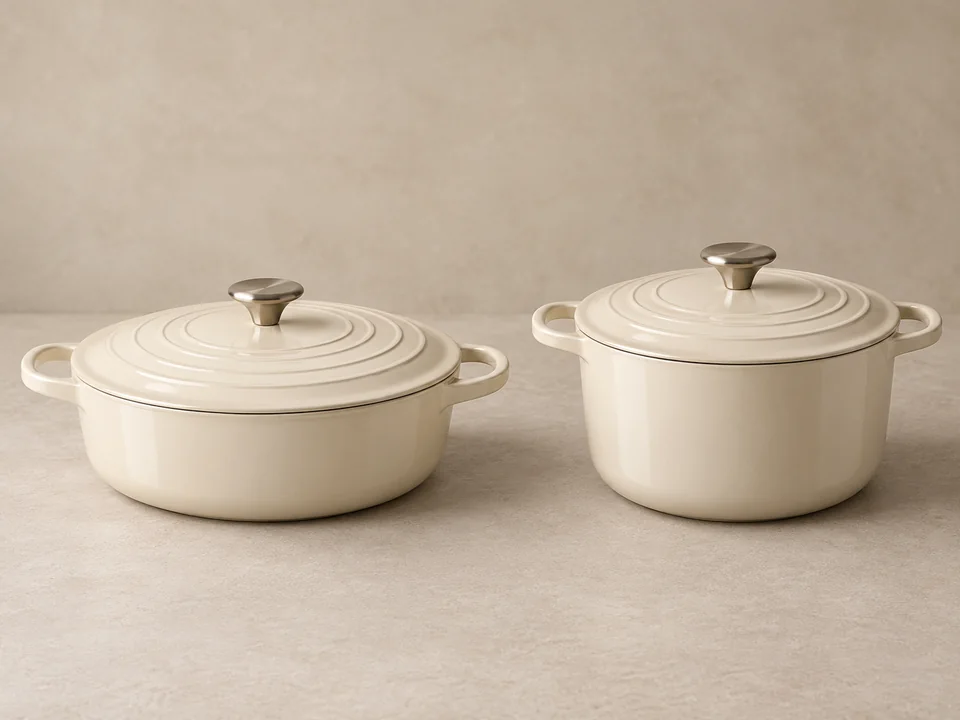
Choosing a Dutch Oven by Cooking Use
Household size is only one part of the decision. The type of cooking you do can also influence which Dutch oven capacity is most practical.
Soups, Stews, and One-Pot Meals
For soups and stews, allow enough room for the ingredients and liquid without filling the pot to the rim. A little additional capacity can make stirring and simmering more convenient.
A medium-sized Dutch oven is often a practical starting point for everyday one-pot meals, while larger models may be preferable for batch preparation.
Braising and Larger Cuts of Meat
When cooking larger cuts of meat, consider the usable internal dimensions as well as the nominal capacity. A pot may have sufficient volume but still be too narrow to accommodate a particular cut comfortably.
The length, width, depth, and shape of the cooking vessel can therefore matter as much as the quart rating.
Bread Baking
For bread baking, the Dutch oven needs to accommodate the dough while leaving sufficient room for expansion. The internal diameter, depth, lid fit, and oven-safe temperature limits of the complete product should all be considered.
A medium-sized pot may be suitable for many individual loaves, but the best choice depends on the dough size, recipe, and product design. Always follow the manufacturer's instructions regarding oven use and temperature limits.
Batch Cooking and Entertaining
If you regularly prepare meals in advance or cook for guests, a larger Dutch oven may reduce the need to prepare multiple batches.
However, a larger pot is not automatically more versatile. It may be heavier to handle, harder to store, and less convenient for small quantities.
Choose the capacity that fits your regular cooking needs rather than selecting the largest model available.
Common Dutch Oven Size Selection Mistakes
A few common mistakes can make an otherwise good Dutch oven less convenient to use.
Choosing by quart capacity alone. Capacity does not fully describe the pot's diameter, depth, or shape. Compare the actual dimensions before deciding.
Ignoring the weight of the complete product. Cast iron cookware is naturally heavy. The weight of the pot, lid, and any accessories can affect handling and storage, especially in larger sizes.
Buying too small for regular cooking habits. A pot that works for individual portions may become inconvenient when preparing larger meals or leftovers.
Choosing an oversized pot for occasional use. Larger capacity can be useful, but it also takes up more storage space and may be unnecessary for small households.
Overlooking lid fit and storage dimensions. The pot should fit the intended storage area, oven, and cooking space. For product comparisons, check both the vessel dimensions and the overall dimensions with the lid.
A good size decision considers the complete product rather than the capacity number alone.
Dutch Oven Sizes for Cookware Brands and Wholesale Buyers
For cookware brands, importers, and retailers, selecting Dutch oven sizes is also an assortment-planning decision.
A product range should reflect the target market, expected customer needs, retail positioning, and the number of SKUs the business can manage effectively.
Build a Practical Size Range
Rather than offering every possible capacity immediately, buyers can begin by identifying a core range of sizes that covers the most important use cases.
For example, a collection might include a smaller pot for compact households, a medium-capacity model for everyday cooking, and a larger option for family meals or batch preparation.
The exact range should be validated against the intended market and customer feedback rather than assumed to be the same for every brand.
Confirm the Complete Product Specifications
For each proposed size, review:
Nominal capacity in quarts and liters.
Internal diameter, depth, and overall dimensions.
Product weight, including the lid where applicable.
Round or oval shape and intended use.
Lid fit, handle design, and knob material.
Available enamel finishes and color options.
Packaging dimensions and protective inserts.
These details help ensure that product listings, samples, quotations, and final specifications remain consistent.
Plan Colors, Packaging, and SKU Combinations
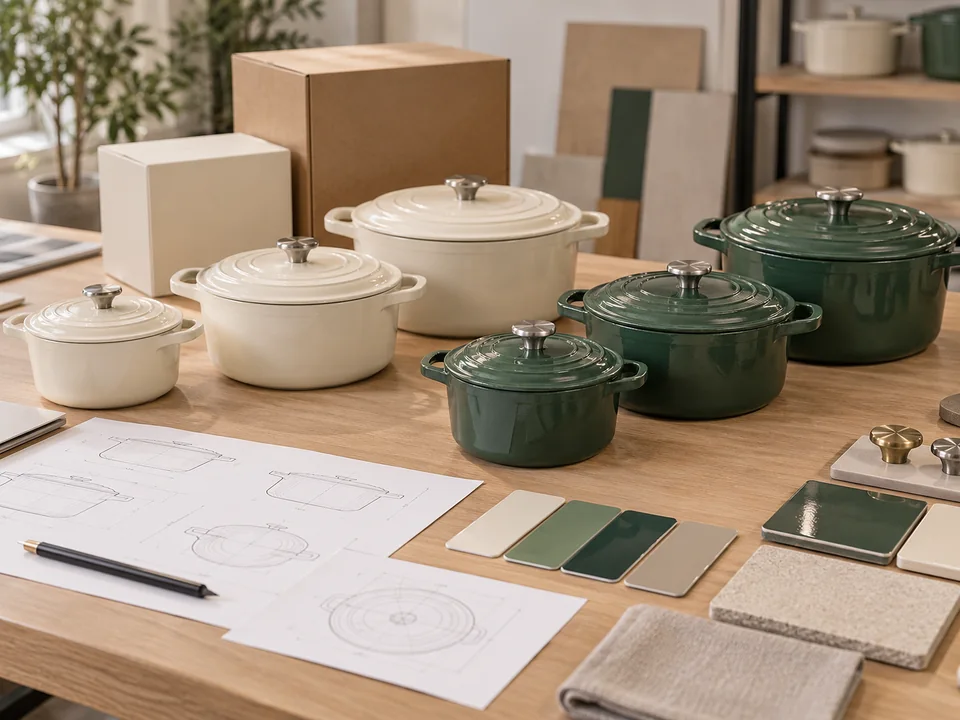
Capacity is only one dimension of a cookware collection. Brands may also need to decide which sizes will be offered in each color, whether selected models will be bundled into sets, and how products will be presented in retail packaging.
Offering every size in every color can increase SKU complexity. A more focused initial range may make it easier to evaluate demand before expanding the collection.
For OEM and private-label projects, confirm the intended assortment, branding requirements, packaging, and order quantities before moving into production.
The Bottom Line
Choosing the right Dutch oven size means balancing capacity, dimensions, cooking habits, and available storage space.
Smaller pots are useful for compact meals and side dishes, medium-sized models provide flexibility for many everyday cooking needs, and larger capacities offer more room for family meals, entertaining, and batch preparation.
For cookware brands and wholesale buyers, a well-planned size range should also account for product specifications, target customers, SKU complexity, and packaging requirements.
Compare capacity in both quarts and liters, review the actual product dimensions, and choose a range that suits the intended use rather than relying on capacity alone.