
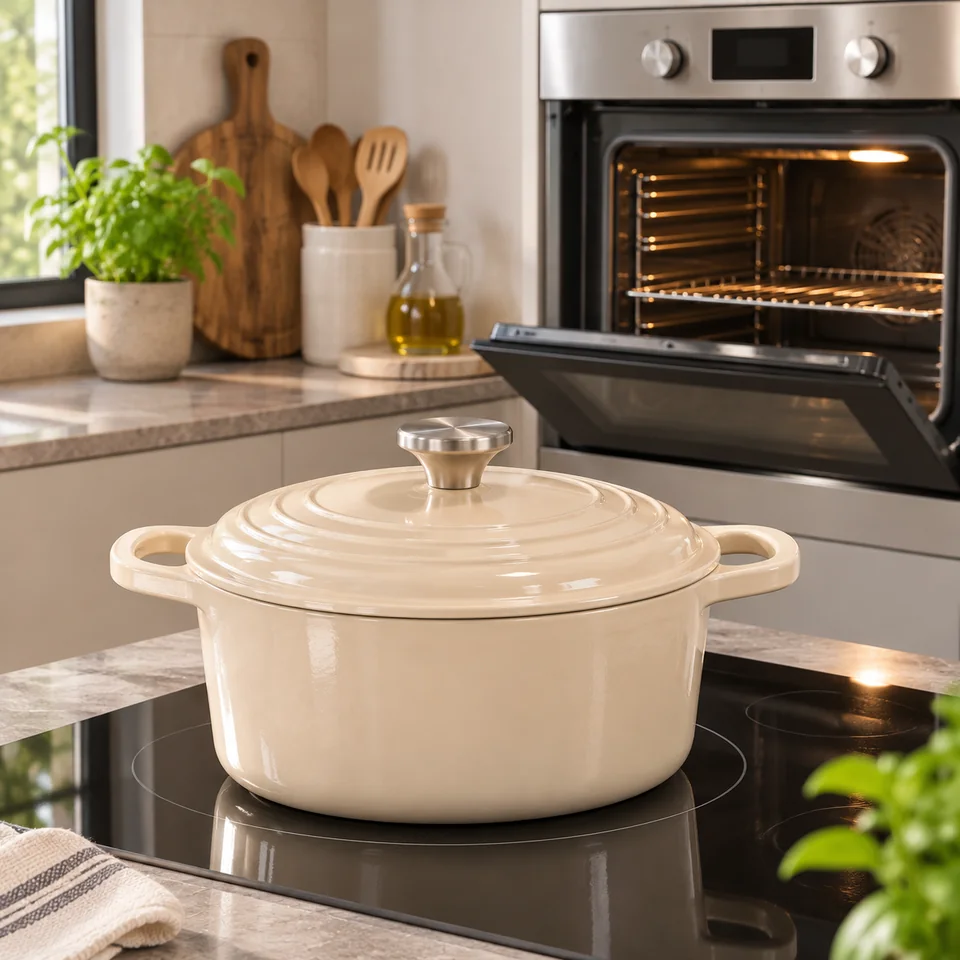
Enameled cast iron cookware is known for its versatility, but can you use it on an induction cooktop, a gas stove, an electric burner, or in the oven?
In most cases, yes. Enameled cast iron cookware is suitable for many common cooking methods because its cast iron body provides the magnetic properties and heat resistance needed for a wide range of applications.
However, compatibility depends on the cookware's base construction, dimensions, handles, lid, and other components. Not every product has the same temperature limits or heat-source restrictions.
Whether you are choosing a Dutch oven for an induction kitchen or checking whether a particular pot can go into the oven, understanding these differences will help you use your cookware safely.
This guide explains how enameled cast iron works with different heat sources, what to check before cooking, and how to avoid unnecessary damage.
Quick Answer: Most enameled cast iron cookware is compatible with induction, gas, and conventional electric cooking when the product is designed for those heat sources. Many models are also oven-safe. However, glass cooktop compatibility and maximum oven temperature should always be confirmed using the manufacturer's instructions for the specific product.
Can You Use Enameled Cast Iron on an Induction Cooktop?
Yes. Enameled cast iron is generally suitable for induction cooking because its cast iron body contains magnetic iron.
Induction cooktops use electromagnetic energy to heat compatible cookware directly. The enamel coating does not normally prevent this process because the magnetic properties come from the cast iron beneath the coating.
However, a suitable material alone is not enough. The shape and dimensions of the cookware base also matter.
How to Check Whether Your Dutch Oven Works on Induction
There are three practical checks.
1. Check the Base With a Magnet
Place a household magnet against the underside of the cookware.
If the magnet sticks to the base, the cookware has magnetic material and may be suitable for induction cooking.
However, a magnet test alone does not guarantee that every induction cooktop will recognize the cookware. The magnetic area, base construction, and minimum cookware diameter also matter.
2. Check the Base Shape
Induction cookware should have a stable, reasonably flat base that makes suitable contact with the cooking zone.
A heavily curved, uneven, or warped base may cause poor contact or inconsistent performance.
3. Match the Pot to the Cooking Zone
Choose an induction zone that is appropriate for the diameter of the cookware base.
If the magnetic base is too small for the cooking zone, some induction cooktops may fail to recognize the cookware or may operate less effectively.
Always check the minimum and maximum cookware dimensions specified by the cooktop manufacturer.
Tips for Using Enameled Cast Iron on Induction
For better cooking performance and surface protection:
Begin heating at a low setting and increase the temperature gradually.
Avoid using the highest power or booster setting for prolonged empty preheating.
Use a cooking zone that matches the cookware base.
Keep the underside of the pot and the cooktop surface clean.
Lift the cookware when moving it rather than sliding it across the glass.
Cast iron retains heat very effectively, so high induction settings are not always necessary.
[INSERT IMAGE 1 HERE — Testing the Magnetic Base of an Enameled Dutch Oven]
Can You Use Enameled Cast Iron on a Gas Stove?
Yes. Enameled cast iron is suitable for gas stoves when the cookware manufacturer approves that heat source.
Gas burners provide direct heat through an open flame, allowing users to adjust the cooking temperature quickly.
The cast iron body absorbs and retains this heat, making it suitable for simmering, braising, boiling, and many other cooking methods.
Choose the Correct Burner Size
The burner should be reasonably close to the diameter of the cookware base.
A very small burner may concentrate heat in the center, while an oversized flame can extend beyond the base and heat the sidewalls.
For best results, use a burner that distributes heat appropriately across the bottom of the pot.
Keep the Flame Beneath the Base
Gas flames should remain within the bottom area of the cookware.
Flames extending up the sidewalls can expose the enamel, handles, and other components to unnecessary direct heat.
This may cause discoloration, overheating, or damage to the cookware.
Avoid Sudden Temperature Changes
Do not transfer a hot Dutch oven directly into cold water.
Allow the cookware to cool gradually before cleaning.
This helps reduce thermal stress on the enamel coating.
Can Enameled Cast Iron Be Used on Electric Stoves?
Yes. Many enameled cast iron products can be used on conventional electric coil and other compatible electric cooking surfaces.
Electric burners provide heat through an electrical heating element rather than an open flame.
One important difference is that electric burners may take longer to heat up and cool down than gas burners.
Because cast iron also retains heat for a long time, temperature adjustments should be made gradually.
Using Enameled Cast Iron on Electric Coil Burners
For conventional electric coil stoves:
Select a burner that matches the cookware base.
Start with a lower heat setting.
Allow the pot to warm gradually.
Reduce the temperature before the cookware becomes excessively hot.
Avoid heating an empty pot at high power.
These steps help prevent overheating and reduce the risk of food sticking or burning.
Can You Use It on a Glass-Ceramic Cooktop?
This requires more attention.
Glass-ceramic cooktops have a smooth surface, but heavy cast iron cookware can potentially scratch, mark, or damage the glass if handled incorrectly.
Some cookware manufacturers approve their enameled cast iron products for smooth-top electric ranges. However, individual appliance manufacturers may have different recommendations.
Before using your cookware, confirm compatibility with both manufacturers.
If approved:
Make sure the cookware base is smooth and clean.
Check that the base is free from rough particles or debris.
Lift the cookware when placing it on or removing it from the cooktop.
Never drag or slide the pot across the glass surface.
Avoid dropping or knocking the cookware against the glass.
The enamel coating can provide a smoother exterior than bare cast iron, but it does not eliminate the need for careful handling.
[INSERT IMAGE 2 HERE — Enameled Cast Iron on Different Stovetop Surfaces]
Can You Put Enameled Cast Iron in the Oven?
Yes. Many enameled cast iron Dutch ovens, casseroles, and skillets are designed for oven use.
The cast iron body retains heat effectively and is suitable for many oven-cooking applications, including:
Slow roasting.
Braising and stewing.
Baking bread.
Cooking casseroles.
Finishing dishes that begin on the stovetop.
One important detail is that the maximum oven temperature is not necessarily determined by the cast iron body.
Other components may have lower temperature limits.
Check the Lid Knob and Handle Materials
The lid knob, handles, and accessories can determine the maximum safe oven temperature.
Different products may use:
Stainless steel knobs.
Phenolic or heat-resistant resin knobs.
Wooden knobs or handles.
Silicone components.
Glass lids.
Enameled cast iron handles.
These materials do not necessarily have the same heat resistance.
For example, Le Creuset publishes different oven-temperature limits for its components:
| Component | Example Maximum Temperature |
|---|---|
| Phenolic knob | 200°C / 390°F |
| Regular or colored stainless steel knob | 260°C / 500°F |
| Glass lid with stainless steel knob | 220°C / 425°F |
| Glass lid with phenolic knob | 200°C / 390°F |
| Enameled cast iron with integral cast iron handles | 350°C / 660°F |
| Wooden handles | Not suitable for oven use |
These figures are examples from Le Creuset's product-specific instructions, not universal limits for all enameled cast iron cookware.
STAUB also specifies different limits for its product configurations: up to 250°C for applicable products, 200°C with silicone components, and 220°C with glass lids.
Always use the lowest applicable temperature limit for the complete cookware assembly.
How to Check Your Dutch Oven's Oven-Safe Temperature
Before placing the cookware in an oven:
Identify the exact product model.
Check the manufacturer's oven-temperature rating.
Confirm whether the lid and knob can remain attached during oven use.
Check whether any silicone, wooden, or other components have separate restrictions.
Never exceed the lowest permitted temperature for the assembled product.
Do not assume that all Dutch ovens have the same oven-safe temperature simply because their bodies are made from cast iron.
Safe Practices When Using Enameled Cast Iron in the Oven
A few simple habits can help protect the cookware:
Always follow the product's maximum temperature rating.
Use oven gloves when handling the pot, lid, and handles.
Place the cookware on an oven rack rather than directly on the oven floor.
Avoid sudden temperature changes.
Do not place a very cold pot directly into a very hot oven unless the manufacturer permits it.
Allow the cookware to cool gradually after cooking.
[INSERT IMAGE 3 HERE — Enameled Dutch Oven Inside a Conventional Oven]
Can Enameled Cast Iron Go Under the Broiler?
Broiler compatibility should be checked separately from ordinary oven compatibility.
A broiler exposes cookware to intense, direct radiant heat, which can be considerably different from conventional oven cooking.
Some enameled cast iron products are approved for broiler or grill use under specific conditions, while others have restrictions.
For example, Le Creuset provides a minimum clearance requirement between the heat source and the cookware rim, and excludes products with certain phenolic knobs or handles from broiler use.
Before using the broiler:
Check whether the exact product is approved for broiling.
Review the maximum temperature and distance requirements.
Check the lid knob and handle restrictions.
Never assume that an oven-safe label automatically means broiler-safe.
If the manufacturer's instructions do not clearly approve broiler use, do not use the cookware under direct broiler heat.
Which Heat Sources Are Compatible With Enameled Cast Iron?
The following table summarizes common compatibility considerations.
| Heat Source | General Compatibility | Important Considerations |
|---|---|---|
| Induction | Yes, for magnetic-compatible products | Check magnetism, base size, and flatness |
| Gas stove | Yes | Keep flames beneath the base |
| Electric coil | Yes, for approved products | Heat gradually and match burner size |
| Glass-ceramic electric | Model-dependent | Check both manufacturers; lift, never slide |
| Radiant cooktop | Model-dependent | Confirm product and appliance instructions |
| Conventional oven | Yes, for oven-rated products | Check the lowest temperature limit of all components |
| Broiler / Grill | Model-dependent | Follow specific clearance and component restrictions |
| Microwave | No | Cast iron is metal and must not be used in a microwave |
The table provides general guidance. Always refer to the instructions for the specific cookware and appliance.
What Heat Sources Should You Avoid?
Although enameled cast iron is versatile, some heating methods should not be used unless the product manufacturer explicitly approves them.
Microwave Ovens
Enameled cast iron is made from metal and is not suitable for microwave cooking.
Metal cookware can interfere with microwave operation and create electrical arcing.
Unregulated Open Flames
Do not assume that an oven-safe Dutch oven can also be used over an open fire, campfire, or outdoor grill.
Unregulated heat can expose the cookware to temperatures and flame patterns beyond its intended use.
Some manufacturers offer specific cast iron products designed for these environments, but that does not automatically apply to all enameled cookware.
Excessive Empty Preheating
Do not heat an empty enameled cast iron pot at high temperature.
Cast iron heats gradually but retains heat for a long time. Excessive empty preheating can lead to overheating and unnecessary stress on the enamel coating.
Use the gradual heating method recommended by the manufacturer.
What Should Cookware Brands and Wholesale Buyers Consider?
For cookware manufacturers, importers, and private-label brands, heat-source compatibility is an important product specification.
Customers increasingly use different cooking appliances, particularly induction cooktops and smooth glass-ceramic ranges.
Buyers should therefore evaluate compatibility before finalizing a cookware collection.
1. Confirm Induction Compatibility
Verify that the cast iron base has the magnetic properties required for induction cooking.
The base should also be appropriately designed for stable contact with the cooktop.
Where necessary, test representative products on different induction cooktop models and sizes.
2. Verify the Complete Product's Oven-Safe Temperature
Do not evaluate only the cast iron body.
The complete product may include a lid, knob, handle, or accessory made from a different material.
For private-label projects, buyers should confirm the temperature rating of each component and establish the maximum temperature for the finished product.
3. Check Surface Finish and Base Construction
The bottom of the cookware should be inspected for smoothness, flatness, and consistency.
This is particularly important for products intended for induction and glass-ceramic cooking surfaces.
The exterior enamel finish should also be checked for defects that could affect normal use.
4. Provide Accurate Product Specifications
For wholesale product listings, packaging, and care documentation, include the relevant compatibility information:
Induction compatibility.
Gas and electric stovetop compatibility.
Glass-ceramic cooktop restrictions.
Maximum oven-safe temperature.
Lid and knob material.
Broiler restrictions, where applicable.
Recommended heating and handling instructions.
Clear specifications help distributors and retailers communicate product capabilities accurately.
5. Match Product Design to the Target Market
Different markets may have different preferences for cooking appliances.
For example, induction compatibility may be particularly important for collections targeting households with modern induction kitchens.
A well-planned product range should consider appliance compatibility alongside capacity, shape, color, weight, and packaging.
For OEM and private-label projects, these requirements should be discussed before final sample approval and mass production.
[INSERT CTA 1 HERE — Explore Our Enameled Cast Iron Cookware]
The Bottom Line
Enameled cast iron cookware is compatible with many common cooking methods, including induction, gas, electric stoves, and conventional ovens.
However, compatibility is not determined by the material alone.
For induction cooking, check the magnetic base and cooking-zone dimensions. For gas stoves, use an appropriately sized burner and keep flames beneath the cookware. For glass-ceramic surfaces, follow the appliance manufacturer's recommendations and always lift the pot instead of sliding it.
When using a Dutch oven in the oven, check the temperature limits of the complete product, including its lid, knob, and handles.
For consumers, these checks help ensure safe and effective cooking.
For cookware brands and wholesale buyers, clearly documented heat-source compatibility is an important part of product development and customer education.