
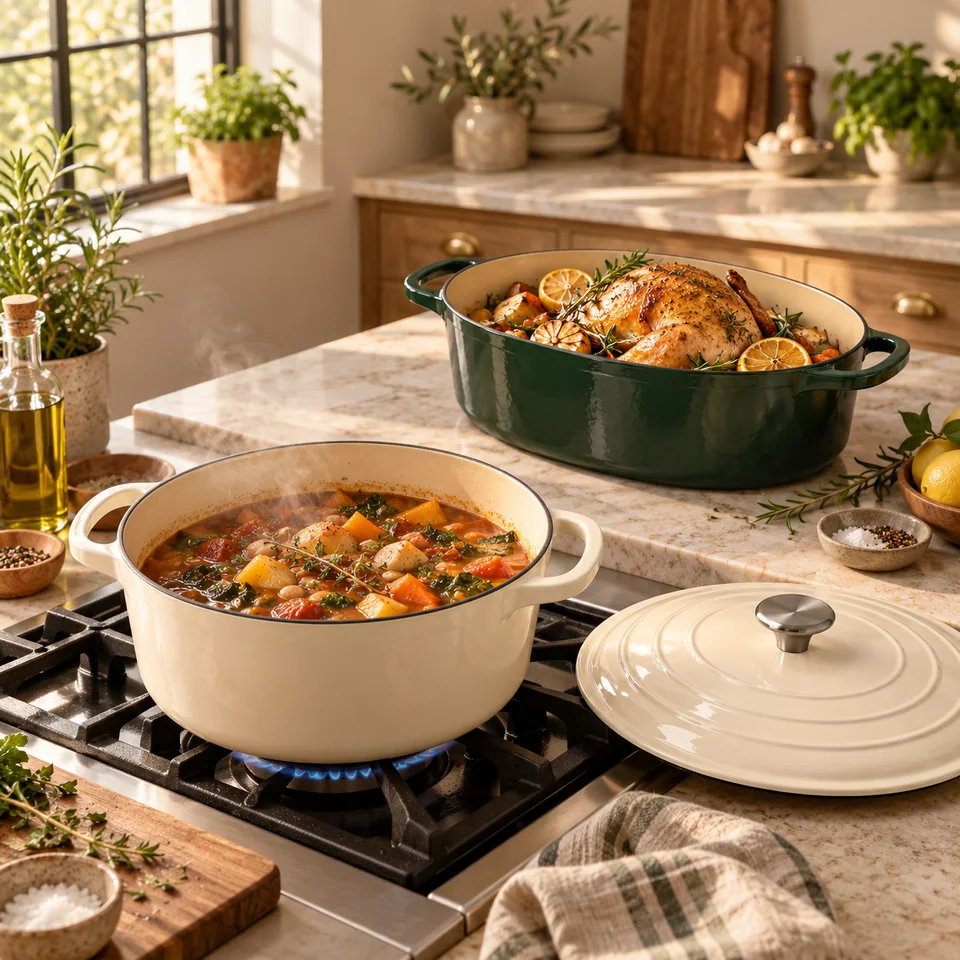
Round and oval Dutch ovens are both versatile pieces of cookware, especially when made from enameled cast iron. They can handle slow cooking, braising, roasting, and bread baking, but their different shapes can make certain tasks easier.
A round Dutch oven fits naturally on many standard stovetop burners and offers a compact shape for everyday cooking. An oval Dutch oven provides extra length, making it particularly useful for whole poultry, longer cuts of meat, and oval-shaped bread.
However, the best choice is not simply about appearance. Burner size, cooking habits, internal dimensions, storage space, and the type of food you prepare all matter.
This guide compares round and oval Dutch ovens to help home cooks and professional cookware buyers select the most practical shape.
Quick Answer: A round Dutch oven is usually the more convenient all-purpose option for stovetop cooking, soups, stews, and round bread loaves. An oval Dutch oven is especially useful for whole chickens, long roasts, and oval bread. Both shapes offer excellent heat retention when properly constructed, so the right choice depends on your cooking needs and available space.
Round vs Oval Dutch Oven: Key Differences
The primary difference between round and oval Dutch ovens is the shape of the cooking vessel.
A round Dutch oven has a circular base and a relatively symmetrical cooking area. An oval Dutch oven has an elongated base that provides additional length for certain ingredients.
Although both shapes can perform many of the same cooking tasks, their proportions affect how they fit on a stove, inside an oven, and in kitchen storage.
| Feature | Round Dutch Oven | Oval Dutch Oven |
|---|---|---|
| Shape | Circular | Elongated oval |
| Stovetop compatibility | Fits many standard round burners | May extend beyond round burners |
| Everyday cooking | Convenient for soups, stews, and braising | Also suitable for everyday cooking |
| Whole poultry | Suitable when the pot is large enough | Often accommodates the shape more naturally |
| Long cuts of meat | Depends on usable diameter | Additional interior length can be helpful |
| Bread baking | Natural fit for round loaves | Convenient for oval loaves |
| Storage | Often more compact | Usually requires more length |
| Heat retention | Depends on materials and construction | Depends on materials and construction |
| Best suited for | General-purpose cooking | Roasting and elongated ingredients |
Neither shape is automatically better in every situation.
For most buyers, the decision should begin with the cooking method and the size of the ingredients rather than the appearance of the pot.
How Does Dutch Oven Shape Affect Stovetop Cooking?
The way a Dutch oven fits over a burner can affect how conveniently it heats and cooks food.
Why Round Dutch Ovens Work Well on Stovetops
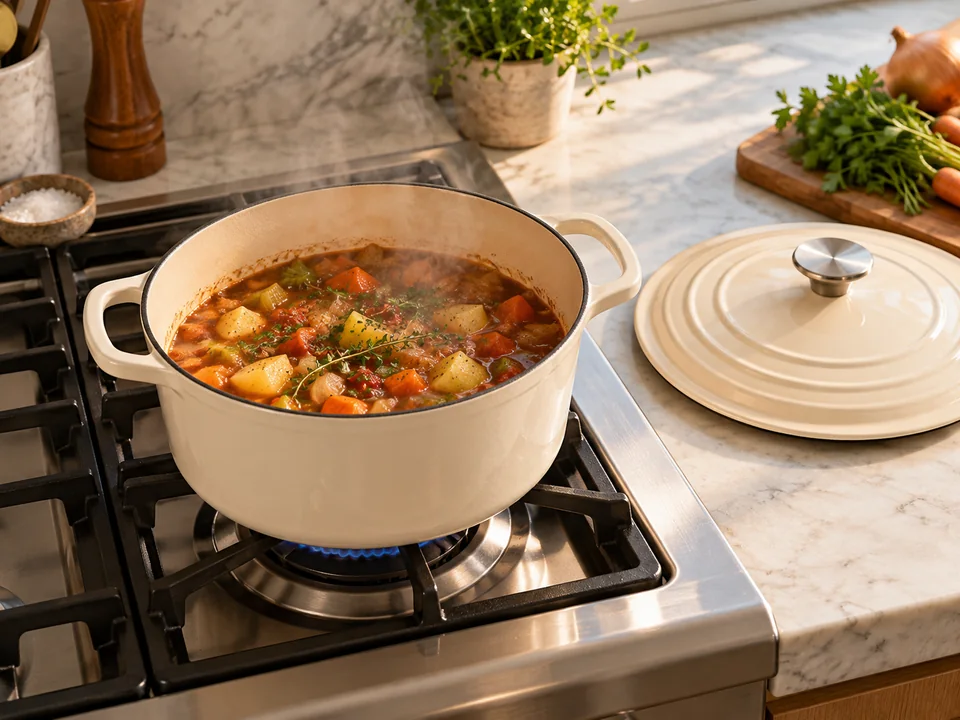
Many household gas, electric, and induction cooking zones are circular. A round Dutch oven is generally easier to center over one of these heating areas.
When the cookware's flat base is appropriately matched to the burner, heat can be applied more evenly across the bottom.
This is particularly convenient for dishes that begin on the stovetop, such as browning meat, sautéing vegetables, or preparing soups and sauces before simmering.
Round Dutch ovens also tend to occupy a more compact area, leaving additional room for other pots and pans.
For everyday stovetop cooking, these practical advantages make the round shape a popular choice.
Can Oval Dutch Ovens Be Used on the Stovetop?
Yes. Oval Dutch ovens can be used on compatible stovetops, but their elongated bases may extend beyond the heated area of a standard round burner.
When this happens, the center of the pot may receive more direct heat than its outer ends, particularly during initial heating.
The cast iron body helps transfer and retain heat, but the burner size, cookware construction, and preheating method still matter.
Some stovetops provide elongated heating zones or bridge elements that can accommodate oval cookware more effectively.
If you cook primarily on a conventional round burner, a round Dutch oven may be the more convenient option. If you frequently cook in the oven, the difference in burner fit may be less important.
When Is an Oval Dutch Oven Better for Roasting?
An oval Dutch oven offers a practical advantage when cooking ingredients that are longer than they are wide.
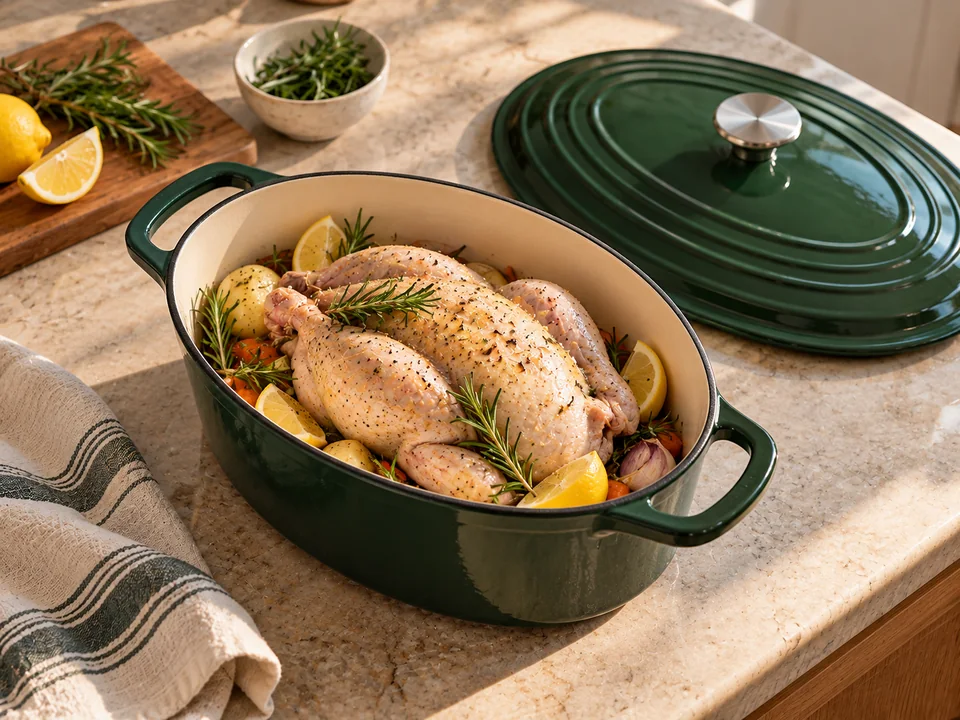
Whole chickens, pork loins, beef roasts, and certain cuts of lamb often fit more naturally into an elongated cooking vessel.
More Room for Whole Poultry
A whole chicken has an elongated shape, particularly when the legs and body are considered together.
An oval Dutch oven can provide additional length around the bird without requiring an equally large circular cooking vessel.
This can make it easier to arrange the chicken with vegetables, herbs, and other ingredients for roasting or braising.
However, shape alone does not guarantee a good fit. The bird's dimensions must still be compared with the pot's usable interior length, width, and depth.
A sufficiently large round Dutch oven can also accommodate a whole chicken.
Better Fit for Longer Cuts of Meat
Longer cuts such as pork tenderloin or certain beef roasts may be easier to arrange in an oval Dutch oven.
The elongated cooking surface can help the meat lie more naturally within the pot instead of requiring it to be folded or divided.
For braising, it also allows room for additional ingredients around the main protein.
The advantage is mainly about usable interior dimensions rather than differences in the cast iron material itself.
Does an Oval Dutch Oven Roast Better?
Not automatically.
Roasting performance depends on the cookware's dimensions, construction, oven temperature, lid design, and the ingredients being cooked.
An oval Dutch oven may be more convenient for certain foods because of its shape, but that does not mean it produces better results for every recipe.
Choose an oval model when the additional length provides a clear practical benefit.
Round or Oval Dutch Oven for Bread Baking?
Both shapes can be used for bread baking when the cookware is designed for the required oven temperature.
The most suitable shape often depends on the shape of the dough.
Round Dutch Ovens for Boules
A round Dutch oven naturally accommodates a round loaf, commonly called a boule.
Its circular cooking area provides a suitable space for the dough to expand while the covered vessel helps retain moisture during the initial baking stage.
Round Dutch ovens are therefore a convenient option for home bakers who regularly prepare round sourdough or other artisan loaves.
Oval Dutch Ovens for Batards
An oval Dutch oven can be useful for longer, oval-shaped loaves, including batards.
The elongated vessel provides additional length while maintaining the enclosed environment associated with Dutch oven bread baking.
Before baking, check that the loaf fits comfortably within the pot and that the complete cookware assembly, including the lid and knob, is rated for the intended oven temperature.
Neither shape is inherently required for bread baking. The practical choice depends on your dough, recipe, and cookware dimensions.
Does Shape Affect Dutch Oven Capacity?
A round Dutch oven and an oval Dutch oven can have the same nominal capacity while providing different usable dimensions.
For example, two pots both labeled 5 quarts may hold a similar total volume, even if one is deeper and more compact while the other is wider or longer.
The difference becomes important when preparing particular foods.
An oval pot may provide more room for a long roast, while a round pot may offer a compact cooking space that is convenient for stirring soups and stews.
Capacity alone cannot tell you whether a particular ingredient will fit.
When comparing cookware, examine:
Nominal capacity in quarts or liters.
Usable interior dimensions.
Depth and base dimensions.
Overall dimensions, including handles.
Lid construction and fit.
If you are choosing between specific sizes, these measurements are often more informative than the round or oval label.
Storage, Weight, and Everyday Handling
Dutch ovens are naturally heavy because of their cast iron construction. Their shape also influences how conveniently they can be handled and stored.
Kitchen Storage
Round Dutch ovens often fit more easily into compact cabinets because of their symmetrical footprint.
Oval models require additional length, which may make them less convenient in narrow storage spaces.
Always check the overall dimensions, including the handles and lid, before choosing a pot for a small kitchen.
Weight and Handling
An oval Dutch oven is not automatically heavier than a round model.
Actual weight depends on the pot's capacity, wall thickness, base design, lid construction, and overall dimensions.
Larger cookware can become particularly heavy when filled with food.
Consider whether you can comfortably lift the pot, move it from the stovetop to the oven, and handle it during cleaning.
Available Oven Space
Oval Dutch ovens may require more horizontal clearance inside the oven.
Check that the product fits on the oven rack with adequate space around it and does not interfere with the oven door or other cookware.
A compact round model may be more practical when oven space is limited.
Which Shape Should You Choose?
The right decision depends on the dishes you prepare most frequently.
Choose a Round Dutch Oven If You:
Frequently prepare soups, stews, and everyday one-pot meals.
Use a standard round stovetop burner.
Want a versatile Dutch oven for different cooking methods.
Often bake round bread loaves.
Prefer a compact shape for storage and handling.
Choose an Oval Dutch Oven If You:
Frequently roast whole chickens or longer cuts of meat.
Want additional length for certain ingredients.
Bake oval-shaped artisan bread.
Have enough stovetop, oven, and cabinet space.
Want to expand an existing cookware collection with another shape.
For many households choosing their first Dutch oven, a round model is a practical starting point because of its versatility.
An oval Dutch oven can be a useful addition for cooks who regularly prepare elongated ingredients or prefer its cooking-space proportions.
The most important consideration is how the cookware will actually be used.
What Should Cookware Brands and Wholesale Buyers Consider?
For cookware brands, importers, distributors, and retailers, the choice between round and oval Dutch ovens is also a product assortment decision.
The most effective collection is not necessarily the one with the largest number of shapes, sizes, and colors.
Instead, buyers should consider the needs of their target customers, the intended retail price positioning, and the complexity of managing multiple SKUs.
Build a Focused Product Range
Round Dutch ovens can provide a versatile foundation for a cookware collection because they support many everyday cooking applications.
Oval Dutch ovens can complement the range by offering an alternative shape for roasting, bread baking, and longer ingredients.
However, the ideal assortment should be based on actual customer demand, sales information, and market positioning.
Brands should avoid assuming that every size must be available in both shapes.
Verify the Actual Product Dimensions
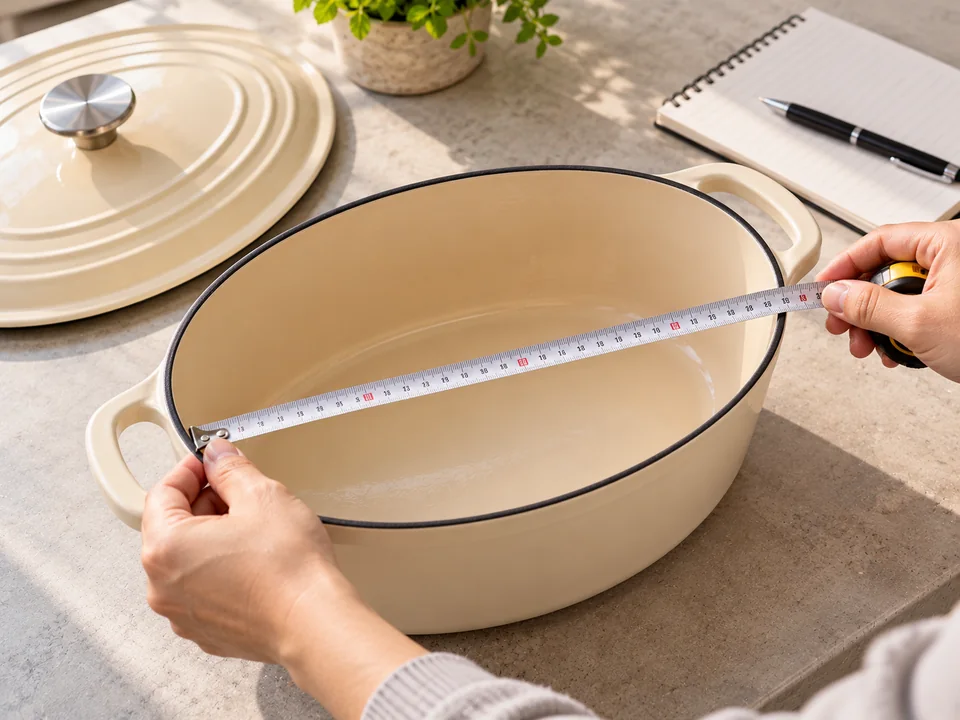
A supplier's stated capacity is important, but wholesale buyers should also confirm the dimensions of the finished product.
For round Dutch ovens, check the internal diameter, depth, and overall dimensions.
For oval models, check the internal length and width separately, along with depth, capacity, and handle-to-handle dimensions.
These measurements help confirm the intended use and ensure consistency between approved samples and production specifications.
Product weight, lid fit, enamel finish, knob material, and packaging requirements should also be included in the product specification.
Evaluate Product Quality and Consistency
When assessing samples, examine the overall cookware construction rather than focusing only on appearance.
Important considerations include enamel finish consistency, rim condition, integrated handle quality, lid alignment, and visible surface defects.
For private-label projects, confirm the intended product specifications, available enamel colors, logo options, and packaging design.
Buyers should also review applicable food-contact requirements and relevant product documentation for their destination market.
Plan Efficient SKU and Packaging Combinations
Offering multiple shapes, sizes, and colors can create an attractive product range, but excessive variation may increase inventory and purchasing complexity.
A focused initial selection can help brands evaluate demand before expanding into additional combinations.
For importers and wholesalers, mixed-SKU or mixed-color orders may provide flexibility when testing a new assortment, subject to the manufacturer's available products, MOQ, and production arrangements.
A well-planned collection balances customer choice with practical sourcing, packaging, and inventory requirements.
The Bottom Line
Round and oval Dutch ovens share many of the same cooking capabilities, but their shapes offer different practical advantages.
A round Dutch oven is usually more convenient for everyday stovetop cooking, soups, stews, and general-purpose use.
An oval Dutch oven provides additional length that can be helpful for whole poultry, larger roasts, and oval-shaped bread.
Neither shape is automatically better in terms of material quality or heat retention.
Before making a decision, compare the cooking applications, capacity, usable dimensions, weight, and available kitchen space.
For cookware brands and wholesale buyers, a carefully selected combination of round and oval products can create a versatile collection while keeping specifications and inventory manageable.