
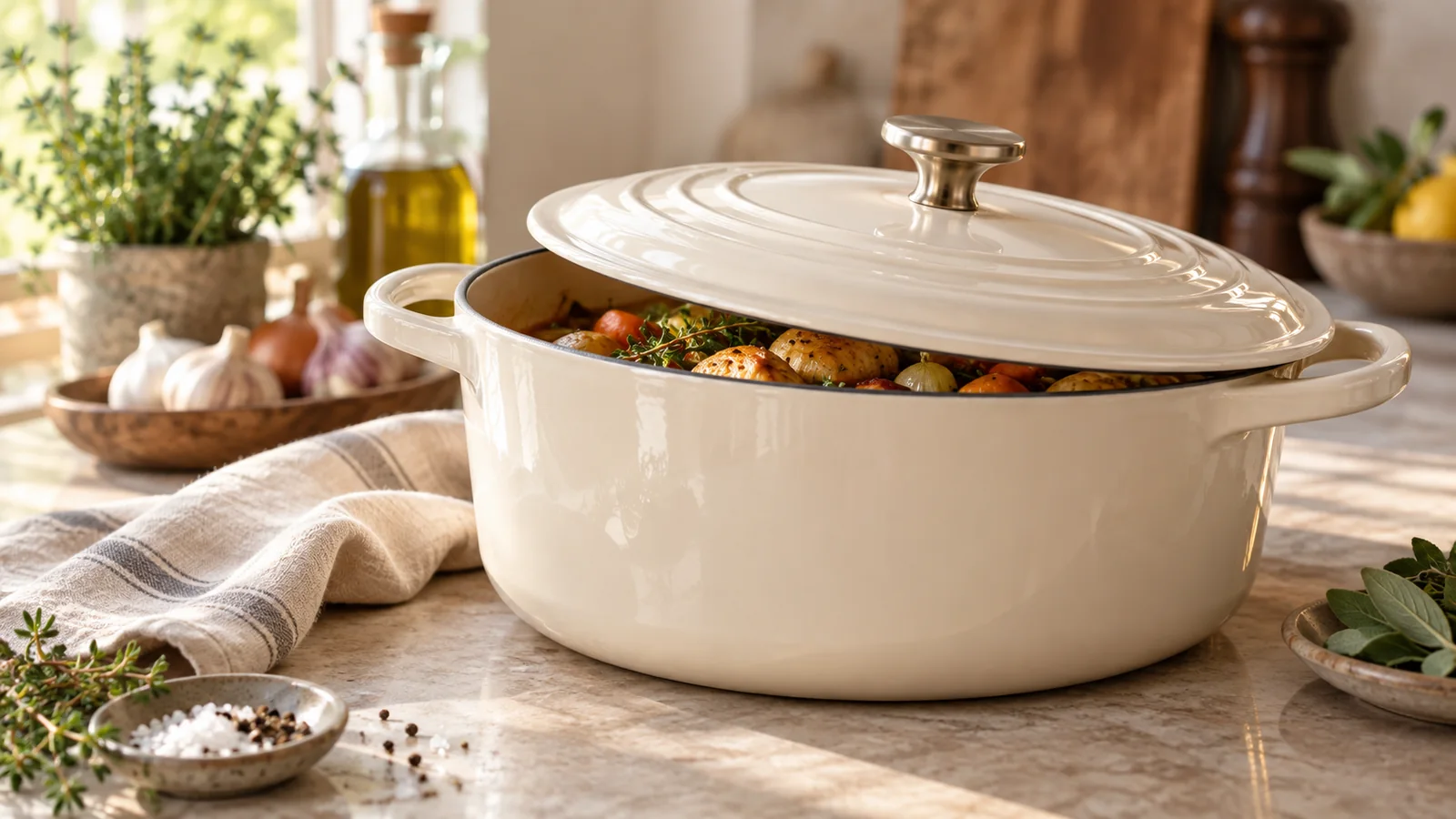
Enameled cast iron is cast iron cookware covered with a hard, glass-like enamel coating. It combines the heat retention and durability of traditional cast iron with a smoother surface that is easier to maintain and available in a wide range of colors and finishes.
The material is commonly used for Dutch ovens, braisers, casseroles, saucepans, skillets, grill pans, and other cookware designed for slow cooking, roasting, baking, simmering, and everyday stovetop use.
Although enameled cast iron and bare cast iron start with a similar iron body, the enamel coating significantly changes the way the cookware looks, performs, and needs to be maintained.
Understanding that construction is useful not only for home cooks but also for brands, importers, and retailers comparing cookware materials or developing a private-label product line.
How Is Enameled Cast Iron Made?
The process starts with the cast iron body.
Molten iron is poured into molds to form the basic cookware shape. After the casting has cooled, the cookware is removed from the mold and prepared for further processing.
The raw casting usually requires cleaning and finishing before enamel can be applied. Surface preparation is important because the enamel must bond consistently to the iron beneath.
A vitreous enamel coating is then applied to the cookware. Depending on the product and manufacturing process, several layers may be used to achieve the required interior surface, exterior finish, color, and appearance.
The coated cookware is then fired at high temperature. During this stage, the enamel softens and fuses to the prepared cast iron surface.
After cooling, the enamel forms the hard finish seen on the completed cookware.
The final product is therefore not simply a painted cast iron pot. The enamel becomes a durable surface bonded to the iron through a controlled firing process.
What Is the Enamel Coating?
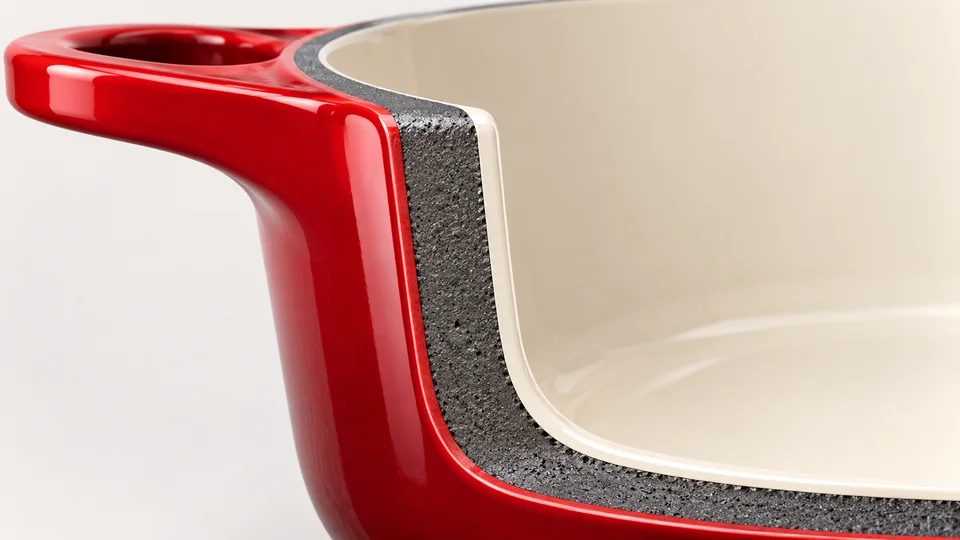
The enamel used on cast iron cookware is generally vitreous enamel, a glass-like inorganic coating designed to bond with the metal surface during firing.
It should not be confused with ordinary paint. Paint normally remains a separate surface coating, while vitreous enamel is fired onto the prepared metal and becomes a hard finish after cooling.
The interior and exterior of the cookware do not always use exactly the same enamel system.
Interior enamel is selected primarily for cooking performance, durability, appearance, and food-contact use. It may be light-colored, dark, glossy, or matte depending on the cookware design.
Exterior enamel offers more freedom for decorative color. This is one of the major commercial advantages of enameled cast iron because cookware brands can create product collections around specific colors and finishes.
A strong enamel finish depends on more than color alone. Surface preparation, coating consistency, enamel formulation, and firing conditions all affect the final result.
Enameled Cast Iron vs Bare Cast Iron
| Feature | Enameled Cast Iron | Bare Cast Iron |
|---|---|---|
| Cooking surface | Vitreous enamel coating | Exposed cast iron |
| Seasoning | Normally not required on enameled surfaces | Regular seasoning is commonly used |
| Color options | Wide range of colors and finishes | Usually natural dark iron finish |
| Acidic foods | Enamel separates food from bare iron | Long cooking with acidic foods may affect seasoning and flavor |
| Maintenance | Easier routine cleaning | Requires more attention to drying and seasoning |
| Rust protection | Enamel helps protect covered surfaces | Exposed iron can rust if not maintained |
| Surface durability | Hard but can chip after strong impact | Cannot chip like enamel but can rust or lose seasoning |
| Appearance | Decorative and retail-friendly | Traditional, functional appearance |
Neither material is automatically better for every cooking situation.
Bare cast iron is valued for simplicity, durability, and the ability to build a seasoned cooking surface over time.
Enameled cast iron adds convenience and design flexibility. The enamel surface reduces the need for seasoning, offers better resistance to corrosion on coated areas, and supports a much wider range of colors and finishes.
For cookware brands and retailers, that visual flexibility can be especially important. Color often plays a major role in the positioning of enameled cookware collections.
The trade-off is that enamel requires more care around impact. While cast iron itself is extremely robust, the fired coating can chip or crack if the cookware is dropped or handled roughly.
What Are the Main Benefits of Enameled Cast Iron?
Excellent heat retention — The cast iron body stores heat effectively and helps maintain steady cooking temperatures.
No routine seasoning on the enamel surface — The coating simplifies maintenance compared with traditional bare cast iron.
Suitable for a wide range of foods — The enamel cooking surface works well for soups, stews, sauces, braising, roasting, and baking.
Wide color selection — Exterior enamel can be produced in many colors, making it suitable for branded cookware collections.
Improved corrosion resistance — Enamel protects covered cast iron surfaces from direct exposure to moisture.
Easy-to-clean surface — A smooth enamel interior is generally easier to maintain than an exposed iron surface.
Strong retail presentation — Glossy finishes, custom colors, lid designs, and knobs give brands more opportunities for differentiation.
Are There Any Limitations?
Enameled cast iron has several advantages, but buyers should also understand its limitations.
The first is weight. Cast iron cookware is heavy, particularly in larger sizes. This can affect handling, packaging, shipping cost, and the overall customer experience.
The enamel surface is also hard but not indestructible. Strong impact, improper handling, or severe thermal shock may result in chips or cracks.
Manufacturing consistency matters as well. Enamel color, coating thickness, surface finish, rim quality, and lid fit need to be controlled across production batches.
This is particularly important for private-label brands. A cookware collection may include several sizes or shapes that need to maintain a consistent color and visual identity.
Packaging also deserves attention because heavy cookware can damage itself or adjacent pieces if it is not protected properly during international transportation.
These limitations do not make enameled cast iron unsuitable. They simply mean that product design, manufacturing control, packaging, and use all need to be considered together.
What Should Buyers Look for in Enameled Cast Iron Cookware?
Professional buyers should evaluate more than the shape and color of a sample.
Start with the casting itself. The cookware should have a stable shape, consistent wall structure, and clean finishing around the rim, handles, and lid contact areas.
Next, examine the enamel. Look for a smooth and consistent surface without obvious areas of poor coverage, large bubbles, contamination, or severe color variation.
Lid fit is another useful quality indicator. The lid should sit consistently on the cookware body without excessive rocking or obvious distortion.
For custom projects, confirm the color using an approved physical sample or agreed standard before production. Screen images are useful for discussion but are not ideal as the only reference for mass-production color.
Packaging should also be tested with the actual product because cast iron cookware is considerably heavier than many other cookware materials.
Finally, buyers should discuss inspection procedures, testing requirements, production lead times, and how the supplier handles quality deviations during mass production.
Final Thoughts
Enameled cast iron is a simple material concept with a surprisingly sophisticated manufacturing process.
The cast iron body provides weight, strength, and heat retention, while the fired enamel creates the smooth cooking surface and decorative finish that distinguish this cookware from traditional bare cast iron.
For consumers, the result is cookware that combines classic cast iron performance with easier maintenance and a broader range of visual styles.
For brands and professional buyers, the enamel layer creates additional opportunities for product differentiation through color, finish, shape, lid design, knobs, logos, and packaging.
The quality of the finished cookware ultimately depends on both parts working together: a well-produced cast iron body and a consistently applied and fired enamel surface.